

01 · The problem
Asking for help starts with recognition.
A visitor with confusing administration or financial matters usually has no need for complicated terms. He wants to understand whether the support suits his situation and what a first contact entails.
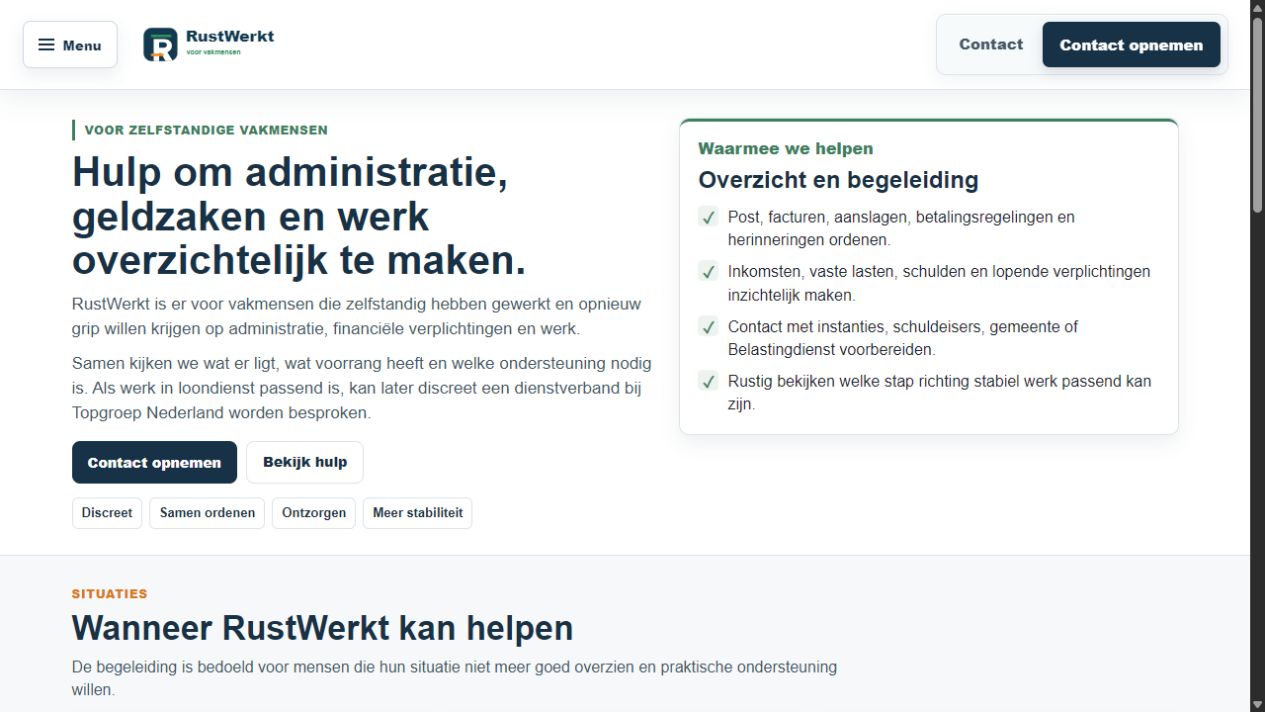
The design issue is therefore also substantive: how do you provide clear explanations without a lot of text or pressure? The website must bring peace to the route that someone can follow.
02 · Inventory
First organize the visitor and his questions.
The concept development focuses on recognizable situations surrounding administration, obligations and work. The questions for a professional are different from those for someone who is involved through work or guidance.
These differences form the basis for the information distribution. The content describes what the support can mean and what steps someone can take to discuss their situation.
03 · Plan of action
From a recognizable situation to a clear next step.
The homepage introduces the support and shows recognizable reasons. Separate pages provide space for the approach and information for different visitors. Contact remains accessible from those routes.
The design supports that order: short text blocks, calm colors and clear buttons. The content doesn't all have to be on the first page.
04 · Construction and further development
Develop the content and design together.
The concept has been developed in HTML, CSS and JavaScript. Navigation, typography and the distribution of information are built as a coherent website, rather than as a separate image of just a homepage.
Further development can then take place per page. Adjustments to explanation, sequence or contact route can be assessed in the working concept before it is possibly used further.
From insight to the next step
What the visitor can do next
| Reason | What you see | The next action |
|---|---|---|
| Visitor recognizes his situation | Brief explanation about administration, finances and work. | Read more about the help that fits that question. |
| Visitor wants to know what will happen | A separate page about the approach. | Assess whether the working method suits the situation. |
| Visitor wants to discuss his question | A clear contact route in the concept. | The step towards finding contact without searching through long texts. |
05 · Implementation
A working concept to assess content.
The technical implementation for this case consists of the local website development with multiple pages. This means that the routes between start, approach, target group information and contact can actually be viewed.
The emphasis in this phase is on useful information distribution: what should someone first understand, which explanation should be on their own page and where does a contact moment fit? The working concept makes those choices concrete.
06 · Testing and checking
Assess whether someone can follow the route.
The relevant controls are in readability, navigation and recognizing the next step. Even on a smaller screen, headings, text and contact buttons must remain in a logical order.
A substantive review can now concern real pages: is the explanation clear, are there questions missing and is the contact route in a usable place? This enables targeted improvements before the website is further deployed.
07 · Delivery
A negotiable website instead of an abstract plan.
The delivered concept shows how the content can work as a website. The pages and navigation provide a basis for further substantive choices and possible follow-up construction.
The value of this phase is that you can view and adjust the structure before possible publication. Further substantive coordination can therefore build on something that already works.
08 · Time savings and insight
Where the profit is in this project
The advantage in this concept phase is that content and design can be assessed together. You can see how the information is distributed and can make targeted adjustments before you continue building. Effects on contact requests or support time have not been measured for this concept.
Clearer information distribution
A recognizable introduction with separate pages for further explanation.
More concrete design choices
The content and navigation can be assessed in a working concept.
Targeted follow-up construction
New insights can be processed per page before the concept is further deployed.